



Nontron Kitchen Knives: Centuries of Heritage on the Cutting Board
Long before modern cutlery hubs industrialized blade making, artisans along the Bandiat River were shaping steel and native boxwood into France’s oldest continuously produced knife. Originating in the medieval town of Nontron in the Périgord Vert region of southwestern France, Nontron knives trace recorded roots back to the 15th century—with blade-craft traditions in the valley dating back to Roman times.
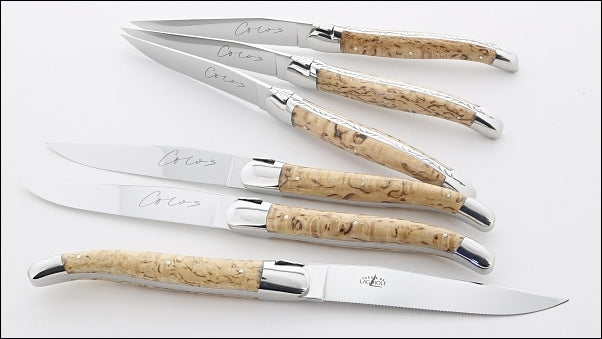
While celebrated for historic folding pocket knives, the cutlery workshop applies this identical centuries-old craft to an exceptional collection of culinary prep tools.
The Birthplace: Nontron & the Périgord Vert
Every authentic Nontron knife is entirely shaped, assembled, and finished by hand in the village of Nontron, located in the Dordogne department. Benefiting from the iron-rich soil of the Périgord and dense, slow-growing boxwood groves native to southwestern France, local cutlers developed an unmistakable profile that has remained largely unchanged for hundreds of years.
Each blade is fitted to dense, slow-cured boxwood (Buxus sempervirens). Boxwood is an exceptionally hard, fine-grained hardwood that naturally resists moisture and culinary wear, developing a warm, golden honey patina over decades of kitchen use.
The Mystical Symbol: The Enigmatic Woodburn
The signature hallmark of an authentic Nontron knife is the delicate geometric motif pyrographically engraved directly into the boxwood handle: an inverted chevron surrounded by three dots, repeated along the wood.
Despite centuries of scholarship and local folklore, the exact meaning of this motif remains an enduring mystery:
- Religious & Trinitarian Roots: The most common historical hypothesis attributes the three dots to the Holy Trinity, while the inverted chevron suggests the compass or divine architecture common in medieval guilds.
- The Knights Templar: Because the Templars maintained commanderies throughout the Périgord and Limousin regions during the Crusades, many believe the motif is an esoteric Templar seal or stonemason maker’s mark passed into cutlery workshops.
- Freemasonry & Guild Markings: The chevron and triad geometry align closely with early French companionage and masonic craft guild insignia, denoting master blade-craft lineage.
- Ancient Archetypes: Others interpret it as a stylized talisman invoking the Greek letter lambda (Λ) or an ancestral solar emblem intended to bring protection and luck to the knife’s owner.
Who Chooses a Nontron Kitchen Knife?
In an era flooded with mass-stamped kitchen knives and clinical industrial aesthetics, Nontron culinary cutlery speaks to a distinct group of cooks, collectors, and design purists:
- The Mindful Home Chef: Cooks who view meal preparation as a tactile, grounding ritual. The warmth, organic curve, and featherweight balance of turned boxwood feel alive in the hand in a way synthetic handles cannot replicate.
- Culinary Traditionalists & Francophiles: Home gourmets who appreciate classic French terroir cooking, regional craftsmanship, and heirloom heritage alongside copper cookware and end-grain cutting boards.
- Collectors of Living History: Individuals drawn to authentic craft over industrial marketing. Holding a Nontron knife means using an uninterrupted piece of French culinary history that predates the Renaissance.
- Aesthetic Minimalists: Those who value rustic elegance, tactile woodcraft, and understated European design where form follows centuries of proven function.